레이블이 Korea인 게시물을 표시합니다. 모든 게시물 표시

2013년 10월 20일 일요일

MANNAM Peace News: DMZ Korean International Documentary Film Festival


The theme of the 5th DMZ International Documentary Film Festival is Peace, Life and Communication of DMZ. The festival is held in  Goyang city - Lafesta (Lotte Cinema, Special Stage), Lake park. Almost 120 films from thirty-eight countries will be shown. The festival started last Thursday (17 Oct.) and ends on Wednesday (23 Oct.). 
The festival includes various events. Tomorrow, for example, there is a bicycle tour, a modern rock concert, and a venue at which people can view documentaries with their animals. For more information check the following website:http://www.dmzdocs.com/eng/main/main.asp

2012 DMZ Documentary Film Festival
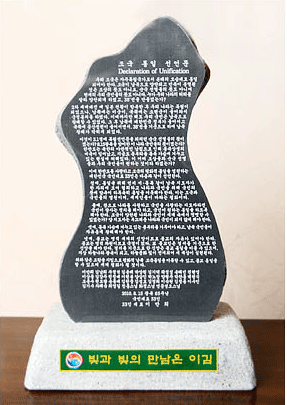
While you are at the DMZ, I strongly encourage you to also visit the Declaration of Unification. This is a powerful and beautiful declaration written by Man Hee Lee and inscribed into the stone shown below. (The English translation is below the picture in blue.) As the Declaration encompasses all the themes of this year's festival and more, seeing it in person would very meaningful and worthwhile. 


Declaration of Unification

This nation must be unified as it was before as an independent nation. Our forefathers who died for this country, and the Korean citizens of today never wished for this nation to be divided.  Who divided our nation and established the 38th parallel?
When the Japanese emperor surrendered after WWII, our country became independent, but the U.S. entered the South, the Russians entered the North, and Korea was basically ruled by the military. Korean citizens were still able to cross back and forth from North to South. Later, the government of the Republic of Korea was established in the South and a communist government was established in the North, and the 38th parallel divided the two. People were no longer allowed to travel back and forth between the two countries. 

Is this what those who died for this country and declared independence in the March 1st (1919) movement wanted? Is this what we, the citizens commemorating Independence Day today, want? The Korean Peninsula was divided because of the North’s barbaric invasion of the South which led to a fratricidal, and bloody war. Even today, we are still pointing guns at people of our own race. How can this be the will of our forefathers and the Korean people today?
Thirty-three people, who represent the citizens of the Republic of Korea, love the Korean Peninsula, and pray for its peace and unification, declare the following:

First, just like East and West Germany, the leaders of South and North Korea must gather to discuss unification for the sake of this country and its citizens.
Second, if our leaders truly love this nation and its citizens, they will work to establish a unified nation the citizens wish for and a country where people live happily in abundance. How can a nation which is divided stand with confidence in this world? The leaders of South and North Korea must ensure that the Korean Peninsula will not be shamed.
Third, we must all lay down our weapons and allow our citizens to travel freely throughout the Korean Peninsula.
Fourth, there must be religious freedom because religion is faith regarding the spiritual world. Religion is a spiritual pursuit, and as such, knows no national boundaries. People of religion must unite through the Scriptures for a religious unification.
By putting these suggestions into action, we can truly achieve world peace.  

Sources:
http://www.dmzdocs.com/eng/about/dmzdocs.asp

https://blogger.googleusercontent.com/img/b/R29vZ2xl/AVvXsEhHlVwfFwZ2KFS1luT_F7wuyZDbxspGQUDaVlHlM6Qddj-yhzdTPcDTtTiH0_NxBAGhvnWyZY4ruutyIhAbVOWcOq2bpQXLLFYkC9Flh2UDSMJwWOe1iu1fDzFdT1wc65VzU5tkgoEgZBLk/s1600/mannam_declaration+of+unification.gif

2013년 5월 13일 월요일

MANNAM with the flower of peace, Mugunghwa(Rose of Sharon)


MANNAM has held the festival of Mugunghwa for world peace in all parts of South, Korea.
MANNAM international Volunteer association has introduced Mugunghwa, Rose of Sharon as an image of Peace which is the national flower of South, Korea.


Making Bi-Bim-Bab(Mixed rice with all the veges and anything you wanna put in) for 100 people
This photo is from Newsis

Full of Mugungwhas in the Korean peninsula
This photo is from MANNAM Cheon-an

Let's get to know this such flower more!


Cultural presentation from Wikipedia

Rose of Sharon is the national flower of South Korea. The first record of the Rose of Sharon (mugunghwa:무궁화) grown in Korea is mentioned in an article produced 1,400 years ago. A mythological fiction, Xuanzhongji (Hanja:玄中記), written in the Eastern Jin Dynasty (Hanja:東晉) of China mentions, "The Land of Wisemen is spread for 1,000 li where mugungwha flowers bloom plentifully."(君子之國,地方千里,多木槿之華) The name "mugungwha" was first used by the poet Lee Gyu-bo (이규보,1168 – 1241) of Goryeo Dynasty.

In the USA, the Rose of Sharon is the official flower of Phi Beta Chi, a national Lutheran-based Greek social letter sorority.

In Canada, Rose of Sharon is a charity that focuses on helping pregnant and parenting young women under the age of 25

In The Grapes of Wrath by John Steinbeck, Rose of Sharon (often called "Rosasharn") is a major character, the eldest daughter of the Joad family and the sister of the protagonist Tom Joad. Throughout much of the novel, she is depicted as fragile because of her pregnancy.

Leonard Bernstein's Kaddish Symphony takes the form of a monologue by a narrator self-identified as Chavatzelet HaSharon, "the lily that man has picked and thrown away."

The song "King's Ransom" from the 1986 Petra album Back to the Street contains a lyric in which the Rose of Sharon symbolizes Jesus Christ.

The song "Rose of Sharon" is on the 1991 Camel album Dust and Dreams

The Rose of Sharon is also referenced in the Kate Bush recording "The Song of Solomon" from her 1993 album The Red Shoes.

The Rose of Sharon is referenced in the Killswitch Engage song "Rose of Sharyn" from their 2004 album The End of Heartache.

There is a song entitled "Rose of Sharon" on Xiu Xiu's 2005 album La Forêt. 

The lyrics seem to allude to both the Song of Solomon and to Steinbeck's novel.

The Ragnarok Online background music set includes a track called "Rose of Sharon".

The village of Rosharon, Texas is named after the "Rose Of Sharon" from the Cherokee Roses that grew nearby.

The Rose of Sharon is referenced in the Bob Dylan song "Caribbean Wind." The song appeared on the compilation album Biograph but was originally recorded during the sessions for Shot of Love.

Leonard Cohen in his original poem "The Traitor" (on which the song "The Traitor" is based) also refers to the Rose of Sharon.

Rose of Sharon is a homeless character in Sherman Alexie's short story "What You Pawn I Will Redeem," published April 21, 2003 in The New Yorker.

In Brazil, Rosa de Saron (Portuguese for Rose of Sharon) is the name of a well-known white rock group, that has include recorded some songs in English.
Sephardic Hebrew poetry from the 10th-15th century demonstrates prolific use of the חבצלת (ḥăḇaṣṣeleṯ) translated into English consistently as "Rose of Sharon"; there are a few renderings as "lily" (see Gate 47 of the Tahkemoni). 

The term and trope are found throughout the Sefer Tahkemoni by Yehuda Alharizi (1165–1225) and much of the poetic corpus of the Golden Age of Iberian Jewish belles lettres, which includes the works of such poets as Shmu'el HaNagid (993-1056), Moses Ibn Ezra (c.1055-after 1138), Yehuda Halevi (c.1075-1141), and Abraham Ibn Ezra (c.1093-c.1167) among others.

"Rose of Sharon" is a song sung by Joan Baez on the album Day After Tomorrow.


Personal and special information from me:)

Personally, if I could give you a little bit more from what I've found about this flower, this flower is unable to be in full blossom, but can be in the republic of Korea. Is that one of reasons for the national flower of Korea?:)