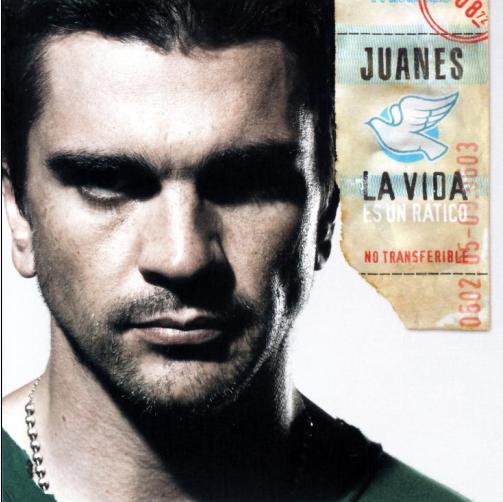
Juanes: Grammy-award-winning musician talks peace with BBC
3 May 2013 Last updated at 17:01 GMT Help
Grammy-award-winning Colombian musician Juanes is known for his passionate lyrics exploring themes of peace and love.
He has sold 16 million albums in his career, making him the world's top all Spanish-language rock artist.
Juanes has also become a global peace activist, inspired by his childhood in Medellin at the height of civil war. His foundation, Mi Sangre, promotes peace in Colombia by empowering youth affected by violence to become agents of change in their communities.
He is also a co-founder of Paz sin Fronteras, an organisation that uses music to promote peace. In 2008, when tensions rose between Colombia, Ecuador and Venezuela, Juanes played a concert on the border between Colombia and Venezuela to call for a peaceful resolution to the conflict.
He has been named one of Time magazine's 100 Most Influential People in the World, and he received an award for distinguished humanitarian leadership from the Atlantic Council in Washington DC. Before the ceremony, Juanes sat down with the BBC's Katty Kay.
+It would be so cool Man Hee Lee and Juanes have a time to talk about peace together.
They both went through war and talk about Peace.
Regardless nationality, race, age, people can be united as ONE for peace
2013년 7월 17일 수요일
2013년 7월 15일 월요일
MANNAM : Word has peace and touches people's heart : Mahatma Gandhi
A coward is incapable of exhibiting love.
It is the prerogative of the brave.
-Mahatma Gandhi-
Mahatma Gandhi
Name: Mahatma Gandhi
Occupation: Anti-War Activist
Birth Date: October 02, 1869
Death Date: January 30, 1948
Education: Samaldas College at Bhavnagar, Gujarat, University College London
Place Of Birth: Porbandar, Kathiawar, India
Place Of Death: New Delhi, India
Full Name: Mohandas Karamchand Gandhi
Born on October 2, 1869, in Porbandar, India, Mahatma Gandhi studied law and came to advocate for the rights of Indians, both at home and in South Africa. Gandhi became a leader of India's independence movement, organizing boycotts against British institutions in peaceful forms of civil disobedience. He was killed by a fanatic in 1948.
Spiritual and Political Leader
Indian nationalist leader Mohandas Karamchand Gandhi, more commonly known as Mahatma Gandhi, was born on October 2, 1869, in Porbandar, Kathiawar, India. He studied law in London, England, but in 1893 went to South Africa, where he spent 20 years opposing discriminatory legislation against Indians. As a pioneer of Satyagraha, or resistance through mass non-violent civil disobedience, he became one of the major political and spiritual leaders of his time. Satyagraha remains one of the most potent philosophies in freedom struggles throughout the world today.
Fight for Indian Liberation
In 1914, Gandhi returned to India, where he supported the Home Rule movement, and became leader of the Indian National Congress, advocating a policy of non-violent non-co-operation to achieve independence. His goal was to help poor farmers and laborers protest oppressive taxation and discrimination. He struggled to alleviate poverty, liberate women and put an end to caste discrimination, with the ultimate objective being self-rule for India.
Following his civil disobedience campaign (1919-22), he was jailed for conspiracy (1922-24). In 1930, he led a landmark 320 km/200 mi march to the sea to collect salt in symbolic defiance of the government monopoly. On his release from prison (1931), he attended the London Round Table Conference on Indian constitutional reform. In 1946, he negotiated with the Cabinet Mission which recommended the new constitutional structure. After independence (1947), he tried to stop the Hindu-Muslim conflict in Bengal, a policy which led to his assassination in Delhi by Nathuram Godse, a Hindu fanatic.
Death and Legacy
Even after his death, Gandhi's commitment to non-violence and his belief in simple living--making his own clothes, eating a vegetarian diet, and using fasts for self-purification as well as a means of protest -- have been a beacon of hope for oppressed and marginalized people throughout the world.
2013년 7월 11일 목요일
MANNAM Peace Advocates : Russell Einstein Manifesto in 1955
![]() |
| via http://pw20c.mcmaster.ca/ |
The full text of Russell Einstein Manifesto
In the tragic situation which confronts humanity, we feel that scientists should assemble in conference to appraise the perils that have arisen as a result of the development of weapons of mass destruction, and to discuss a resolution in the spirit of the appended draft.
We are speaking on this occasion, not as members of this or that nation, continent, or creed, but as human beings, members of the species Man, whose continued existence is in doubt. The world is full of conflicts; and, overshadowing all minor conflicts, the titanic struggle between Communism and anti Communism.
Almost everybody who is politically conscious has strong feelings about one or more of these issues; but we want you, if you can, to set aside such feelings and consider yourselves only as members of a biological species which has had a remarkable history, and whose disappearance none of us can desire.
We shall try to say no single word which should appeal to one group rather than another. All, equally, are in peril, and, if the peril is understood, there is hope that they may collectively avert it.
We have to learn to think in a new way. We have to learn to ask ourselves, not what steps can be taken to give military victory to whatever group we prefer, for there are no longer such steps; the question we have to ask ourselves is: what steps can be taken to prevent a military contest of which the issue must be disastrous to all parties?
The general public, and even many men in position of authority, have not realized what would be involved in a war with nuclear bombs. The general public still thinks in terms of obliteration of cities. It is understood that the new bombs are more powerful than the old, and that, while one A-bomb could obliterate Hiroshima, one H- bomb could obliterate the largest cities, such as London, New York and Moscow.
No doubt in an H-bomb war great cities would be obliterated. But this is one of the minor disasters that would have to be faced. If everybody in London, New York and Moscow were exterminated, the world might, in the course of a few centuries, recover from the blow. But we know, especially since the Bikini test, that nuclear bombs can gradually spread destruction over a very much wider area than had been supposed.
It is stated on very good authority that a bomb can now be manufactured which will be 2,500 times as powerful as that which destroyed Hiroshima. Such a bomb, if exploded near the ground or under water, sends radioactive particles into the upper air. They sink gradually and reach the surface of the earth in the form of a deadly dust or rain. It was this dust which infected the Japanese fishermen and their catch of fish.
No one knows how widely such lethal radioactive particles might be diffused, but the best authorities are unanimous in saying that a war with H-bombs might quite possibly put an end to the human race. It is feared that if many H-bombs are used there will be universal death—sudden only for a minority but for the majority a slow torture of disease and disintegration.
Many warnings have been uttered by eminent men of science and by authorities in military strategy. None of them will say that the worst results are certain. What they do say is that these results are possible, and no one- can be sure that they will not be realized. We have not yet found that the views of experts on this question depend in any degree upon their politics or prejudices. They depend only, so far as our researches have revealed, upon the extent of the particular expert's knowledge. We have found that the men who know most are the most gloomy.
Here, then, is the problem which we present to you, stark and dreadful and inescapable: shall we put an end to the human race; or shall mankind renounce war? People will not face this alternative because it is so difficult to abolish war.
The abolition of war will demand distasteful limitations of national sovereignty. But what perhaps impedes understanding of the situation more than anything else is that the term "mankind" feels vague and abstract. People scarcely realize in imagination that the danger is to themselves and their children and their grandchildren, and not only to a dimly apprehended humanity. They can scarcely bring themselves to grasp that they, individually, and those whom they love are in imminent danger of perishing agonizingly. And so they hope that perhaps war may be allowed to continue provided modern weapons are prohibited.
This hope is illusory. Whatever agreements not to use H-bombs had been reached in time of peace, they would no longer be considered binding in time of war, and both sides would set to work to manufacture H-bombs as soon as war broke out, for, if one' side manufactured the bombs and the other did not, the side that manufactured them would inevitably be victorious.
Although an agreement to renounce nuclear weapons as part of a general reduction of armaments would not afford an ultimate solution, it would serve certain important purposes. First: any agreement between East and West is to the good insofar as it tends to diminish tension. Second: the abolition of thermo-nuclear weapons, if each side believed that the other had carried it out sincerely, would lessen the fear of a sudden attack in the style of Pearl Harbour, which at present keeps both sides in a state of nervous-apprehension. We should, therefore, welcome such an agreement, though only as a first step.
Most of us are not neutral in feeling, but as human beings, we have to remember that, if the issues between East and West are to be decided in any manner that can give any possible satisfaction to anybody, whether Communist or anti- Communist, whether Asian or European or American, whether White or Black, then these issues must not be decided by war. We should wish this to be understood, both in the East and in the West.
There lies before us, if we choose, continual progress in happiness, knowledge, and wisdom. Shall we, instead, choose death, because we cannot forget our quarrels? We appeal, as human beings, to human beings: remember your humanity, and forget the rest. If you can do so, the way lies open to a new Paradise; if you cannot, there lies before you the risk of universal death.
+Resolution
We invite this Congress, and through it the scientists of the world and the general public, to subscribe to the following resolution:
In view of the fact that in any future world war nuclear weapons will certainly be employed, and that such weapons threaten the continued existence of mankind, we urge the Governments of the world to realize, and to acknowledge publicly, that their purpose cannot be furthered by a world war, and we urge. them, consequently, to find peaceful means for the settlement of all matters of dispute between them.
Professor Max Born (Professor of Theoretical Physics at Berlin, Frankfurt, and Gottingen, and of Natural Philosophy, Edinburgh; Nobel Prize in physics)
Professor P.W. Bridgman (Professor of Physics, Harvard' University; Nobel Prize in physics)
Professor Albert Einstein
Professor L. Infeld (Professor of Theoretical Physics, University of Warsaw)
Professor J. F. Joliot-Curie (Professor of Physics at the College de France; Nobel Prize in chemistry)
Professor H. J. Muller (Professor of Zoology at the University of Indiana; Nobel Prize in physiology and medicine)
Professor Linus Pauling (Professor of Chemistry, California Institute of Technology; Nobel Prize in chemistry)
Professor J. Rotblat (Professor of Physics, University of London; Medical College of St. Barnholomew's Hospital)
Bertrand Russell
Professor Hideki Yukawa (Professor of Theoretical Physics, Kyoto University; Nobel Prize in physics (Rotblat 1972)
+This became Albert Einstein's will since he died in 18 days after he signed this manifesto eventually.
2013년 7월 10일 수요일
MANNAM : Word has peace and touches people's heart : Martin Luther King Jr
Darkness cannot drive out darkness: only light can do that.
Hate cannot drive out hate: only love can do that.
Martin Luther King Jr
from A Testament of Hope: The Essential Writings and Speeches
Martin Luther King Jr'sEarly life and education
Martin Luther King, Jr. was born on January 15, 1929, in Atlanta, Georgia, to Reverend Martin Luther King, Sr. and Alberta Williams King. His legal name at birth was "Michael King". King's father was also born Michael King. The father “changed” both names on his own during a 1934 trip to Nazi Germany to attend the Fifth Baptist World Alliance Congress in Berlin. It was during this time he chose to be called Martin Luther King in honor of the great German reformer Martin Luther.
Martin, Jr., was a middle child, between an older sister, Willie Christine King, and a younger brother, Alfred Daniel Williams King. King sang with his church choir at the 1939 Atlanta premiere of the movie Gone with the Wind.
King was originally skeptical of many of Christianity's claims. At the age of thirteen, he denied the bodily resurrection of Jesus during Sunday school. From this point, he stated, "doubts began to spring forth unrelentingly". However, he later concluded that the Bible has "many profound truths which one cannot escape" and decided to enter the seminary.
Growing up in Atlanta, King attended Booker T. Washington High School. A precocious student, he skipped both the ninth and the twelfth grades and entered Morehouse College at age fifteen without formally graduating from high school. In 1948, he graduated from Morehouse with a B.A. degree in sociology, and enrolled in Crozer Theological Seminary in Chester, Pennsylvania, from which he graduated with a B.Div. degree in 1951. King married Coretta Scott, on June 18, 1953, on the lawn of her parents' house in her hometown of Heiberger, Alabama. They became the parents of four children: Yolanda King, Martin Luther King III, Dexter Scott King, and Bernice King.
King became pastor of the Dexter Avenue Baptist Church in Montgomery, Alabama, when he was twenty-five years old, in 1954. King then began doctoral studies in systematic theology at Boston University and received his Ph.D. degree on June 5, 1955, with a dissertation on "A Comparison of the Conceptions of God in the Thinking of Paul Tillich and Henry Nelson Wieman". An academic inquiry concluded in October 1991 that portions of his dissertation had been plagiarized and he had acted improperly, but that his dissertation still "makes an intelligent contribution to scholarship"; the committee recommended that his degree not be revoked.
+LOVE
2013년 7월 9일 화요일
MANNAM peace : North female footballers to play here
![]() |
| via EAFF homepage |
The South Korean government approved the visit of North Korea’s national female football team to participate in the fifth 2013 EAFF East Asian Cup, a regional championship competition held in Seoul and Gyeonggi.
Seoul’s Unification Ministry announced its approval in a press release yesterday for the visit of a total of 36 North Korean football players and officials to the South, which was requested by the head of the Korea Football Association, the South Korean organization in charge of arranging the event this year.
The North Korean women’s team hasn’t played in the South since 2005.
![]() |
| via sportsbasha |
The competition, which already completed the preliminary round in Hong Kong, will be held at the Seoul World Cup Stadium in Sangam-dong, Seoul Olympic Stadium, Jamsil and the Hwaseong Stadium in Gyeonggi, from July 20-28.
For the women’s matches, four teams are listed at the final tournament - South Korea, North Korea, China and Japan. North Korea’s male team lost in the preliminary round in Hong Kong.
According to the ministry, they will arrive at the Incheon International Airport via Beijing on July 18 and have three matches - one with South Korea on July 21, Japan on July 25 and China on July 27. They are scheduled to return to the country on July 28.
Along with the team, a total of 41 members of the General Association of Korean Residents in Japan, an association of North Koreans residing in Japan, will also visit the South to cheer their team.
The South’s Foreign Ministry is taking legal steps to approve their entrance, the ministry said, and their itinerary is not scheduled yet.
In an effort to improve the competence of players of East Asian countries, the EAFF Cup was launched in 2002. A total of 11 nations in the East Asian region attend the competition, which has been held irregularly. All of the costs for the flight tickets, accommodation and other fees during the competition are covered by the East Asian Football Federation.
By Kim, Hee-jin [heejin@joongang.co.kr]
Sports is something very precious among what people do together.
People learn the spirit of team work which can be widen to the idea that people can not live alone via sports.
So many international youth organizations do many sports like MANNAM has Victorycup and etc.
I am personally not that interested in doing exercize.
I am not an athlete pesron but I agree I need to exersize.
:)
2013년 7월 8일 월요일
MANNAM Volunteer Association, 'Planting trees with a city, Chang-won'

A city, Chang-won hold an environmentally friendly event for Arbor Day with MANNAM, Volunteer Association.
About 200 citizens gathered at Sang-bok dong, Sung-san gu with Wan-soo Park, a mayor of Chang-won and planted 2000 Japanese cypress trees around Sang-bok park.
Members of MANNAM, Dan-bi club, Marine Cheon-woo-hye(club), Mt.Jin-hae love society and other communities planted all the trees for 2 hours.
The mayor speeched "Thanks for joining such good work and hope all the organizations keep it up for a city, Chang-won and the citizens".
Myung-ja Choi, a volunteer said "I am so proud of today's volunteer work working with my city, Chang-won for practical and actual help reaching this society and citizens as I am a citizen myself. I'd love to keep volunteering up".
+ How to get a mature sense of citizenship
1.Knowing of my city well
ex.location, population, own history..etc
2.Knowing of what my city needs
ex.lack of nature -> planting trees like this event.
3.Having a positive attitude of my city.
ex.Even though, my city is such a small city with nothing, I can think like it is a good place to chill out and enjoy reflection or something....(lol)
4.Acting out with creative ideas
-Do it, anyways
2013년 7월 4일 목요일
MANNAM Youth for Peace : Filipino youth at WYD in Rio, "hope" of the Church and society
Manila (AsiaNews) - The new generation "are the hope of the Church and society" and it is "our duty" to educate them to become "good and devoted elements " within society as a whole. This is the message delivered by leaders of the Diocese of Pasig - a suffragan of the Archdiocese of Manila, in the Philippines - to the participants at the 28th World Youth Day (WYD), scheduled for July 23 to 28 next to Rio de Janeiro, Brazil. On Sunday, June 30 at the Cathedral of the Immaculate Conception of Pasig Mass was celebrated mandating the diocesan delegates, who will meet Pope Francis and young people from around the world in the metropolis of Rio. Bishop Mylo Hubert Vergara emphasized the importance of "being a missionary for others."
During the Mass, the bishop reminded participants of the importance of their mission and the special experience they will have. Msgr. Vergara added that it is a "once in a lifetime" opportunity and the meeting with the Pope must be lived in communion "with whole world." "Not everyone has the opportunity to see the Pope in person - he continues - and ... that's why your presence is not only a personal experience. You represent the nation. All of us will be there with you."
In his homily Fr. Joeffrey Brian Catuiran, diocesan youth ministry director, spoke of the importance of young people in the missionary task promoted by the Church, under the motto "go and make disciples of all nations." "Young people are the hope of the Church and of society - said the priest - and we need to help them become [as Pope emeritus Benedict XVI pointed out] good and devout members of the community."
Fr. Catuiran echoed the words of Pope Francis inviting the young people "not to be ashamed to carry the Cross" and to prepare for this special World Youth Day event at "a spiritual level". So that it may be "a sign of faith for the entire world. Welcoming the love of Christ, who embraces us" just like the Redeemer statue that overlooks the city of Rio.
More than 300 young Filipinos will participate in the WYD in Brazil. Accompanying them will be the President of the Philippine Bishops Conference and Archbishop of Cebu Jose Palma, along with four other bishops and numerous priests. The number of young Filipinos, however, could be much higher, because many schools, institutes, autonomous communities are organizing delegations that will be present in Rio for the days of celebration and prayer. The "official" Episcopal Conference delegation leaves for Brazil between July 13 and 15, in time to celebrate the missionary days 17-21. They will be hosted by the Diocese of Petropolis, about 70 km from Rio de Janeiro
+Adults and whole world have hope on Youth for Peace.
Some genuine heart, some willingness for others, some positive energy can inspire all the societies...
Those values are seen through YOUTH.
I hope all the international youth gather together and step forward for ONE purpose, World Peace.
That would be so amazing and touching.
Will be more of Youth gathering than before.
So YOUTH guys!
Are you ready to become main characters who can change the world?:)
피드 구독하기:
글 (Atom)